By Dr Janagan Vinayagamoorthy
Sri Lanka is passing through a historic phase. The economic collapse was not just about money. It damaged dignity, trust, and confidence. Families lost savings. Young people lost hope. Many citizens stopped believing that politics can improve their lives.
In such a moment, democracy depends not only on the government in power, but also on the strength and quality of the opposition. A weak opposition leaves the country without direction. A reckless opposition creates fear and instability. Both are dangerous.
So the real question Sri Lanka must ask today is this: Does our opposition truly understand its responsibility to the nation, or is it only focused on survival and elections?
Opposition politics is often misunderstood. Many believe opposition means shouting in Parliament, attacking leaders personally, or organising protests whenever possible. These actions may create attention, but attention alone does not rebuild a country.
In times of national crisis, opposition must rise above routine politics. It must offer clarity, discipline, and courage. Sri Lanka does not need a routine opposition. It requires a corrective opposition.
Beyond Personalities. Fixing a Broken System
Sri Lanka’s failure did not start with one leader, one family, or one political party. Different governments came and went, but the same habits remained. Debt kept increasing. Long-term planning was ignored. Institutions became weak. Power was concentrated, and accountability disappeared.
Blaming one individual may satisfy anger, but it does not protect the future. Removing one leader without changing the system only prepares the ground for the subsequent failure.
The opposition must therefore focus on explaining how the system failed. How were major economic decisions taken? Why were experts ignored? Why did Parliament fail to act as a watchdog? Why did independent institutions lose courage?
This work is not dramatic, but it is essential. It requires studying laws, budgets, and procedures. It requires asking uncomfortable questions again and again. It requires educating the public patiently.
If the opposition does not fix the systems, Sri Lanka will continue to change leaders but keep repeating disasters. Real reform begins when systems change, not faces.
Moral Authority Is More Important Than Speeches
Sri Lankan people have heard many speeches. Promises were made during elections and forgotten afterwards. Today, people no longer believe words easily. They observe actions closely.
The opposition must therefore build moral authority through behaviour. Corruption must be rejected entirely, not selectively. If wrongdoing happens within the opposition’s own ranks, it must be exposed and corrected openly.
Protecting friends, relatives, or loyal supporters who act wrongly destroys credibility. Staying silent for political convenience sends a dangerous message. People notice hypocrisy very quickly.
Moral authority grows when leaders choose truth over comfort and admit mistakes, hold their own people accountable, and show the same standards to everyone.
Without moral authority, opposition becomes noise. With moral authority, even quiet opposition gains power and respect.
A National Voice, Not Only a Colombo Voice
Sri Lanka is not only Colombo. It is villages, estates, fishing towns, border areas, and remote regions. Yet opposition politics often remains city-focused and media-driven.
A serious opposition must spend time outside Colombo. It must listen, not lecture. Farmers worry about crops, prices, and debt. Fisher families worry about fuel, income, and safety. Estate workers worry about housing, wages, and dignity. Young people worry about jobs and migration.
The opposition must also speak clearly to all communities. Sinhala rural families want economic security and respect. Tamil communities wish for dignity, justice, and equality. Muslim citizens want safety and fair treatment. Estate workers want recognition as equal citizens.
Unity cannot be created through slogans or banners. It grows when people feel that leaders understand their daily struggles. An opposition that speaks only to elites cannot rebuild national trust.
Competence Is a Duty, Not a Choice
Sri Lanka’s problems are not simple. Debt restructuring, IMF programmes, tax changes, education reform, and economic planning require a deep understanding.
The opposition must be technically prepared. It must understand the details and explain them in simple language. Criticism without knowledge creates fear. Knowledge without explanation creates distance.
People want to know the alternative plan. They want to know what will change, what will remain difficult, and how long recovery will take. They want honesty, not fantasy.
Competence also means admitting limits. Not every problem has an easy solution. A responsible opposition explains trade-offs clearly and respects citizens’ intelligence.
Without competence, people fear that change may lead to another collapse rather than recovery.
Protect Democracy Without Creating Chaos
Sri Lanka has already experienced chaos. People remember fuel queues, power cuts, and fear. Many now value stability because they know how fragile life can become.
The opposition must protect democracy with care. Protest is a democratic right, but reckless agitation can weaken institutions and harm ordinary people.
Strong opposition means defending Parliament, courts, elections, and the rule of law. It means opposing abuse of power firmly, but responsibly. It means resisting authoritarian actions without destroying stability.
Democracy grows through strong institutions, not broken ones. Chaos may feel powerful in the moment, but it leaves long-term damage.
Bring New Leaders, Not Old Faces Again
There is a deep gap between politics and young people. Many young citizens feel politics is closed, dishonest, and repetitive.
This is not because young people do not care about the country. It is because they see the same faces, the same families, and the same behaviour repeated for decades.
The opposition must create real space for new leadership. Young leaders must be trusted with responsibility, not just used for campaigns. Leadership must be based on ability, honesty, and service.
Renewal is not about age alone. It is about changing political culture. Without new thinking, old mistakes will return again and again.
Speak Honestly About Reconciliation
Sri Lanka avoided difficult conversations for too long. Silence replaced truth. Avoidance replaced justice. This created deep mistrust and unresolved pain.
The opposition must speak honestly about reconciliation. Accountability is necessary, but it must be fair. Justice must exist, but without revenge. Equality must be protected, without fear.
Ignoring the past does not heal the future. Recognition of pain, honest dialogue, and equal citizenship are essential.
Reconciliation is not weakness. It is the foundation of long-term peace and national stability.
Think Beyond the Next Election
Too often, opposition politics is focused only on winning the next election. This short-term thinking has deeply harmed Sri Lanka.
The country needs a long-term vision. What kind of education system will prepare future generations? How can the economy move beyond debt and dependency? How can institutions be protected from political interference?
An opposition must clearly explain where Sri Lanka should be in ten or twenty years. Vision gives meaning to power. Without vision, leadership becomes empty.
The Real Test
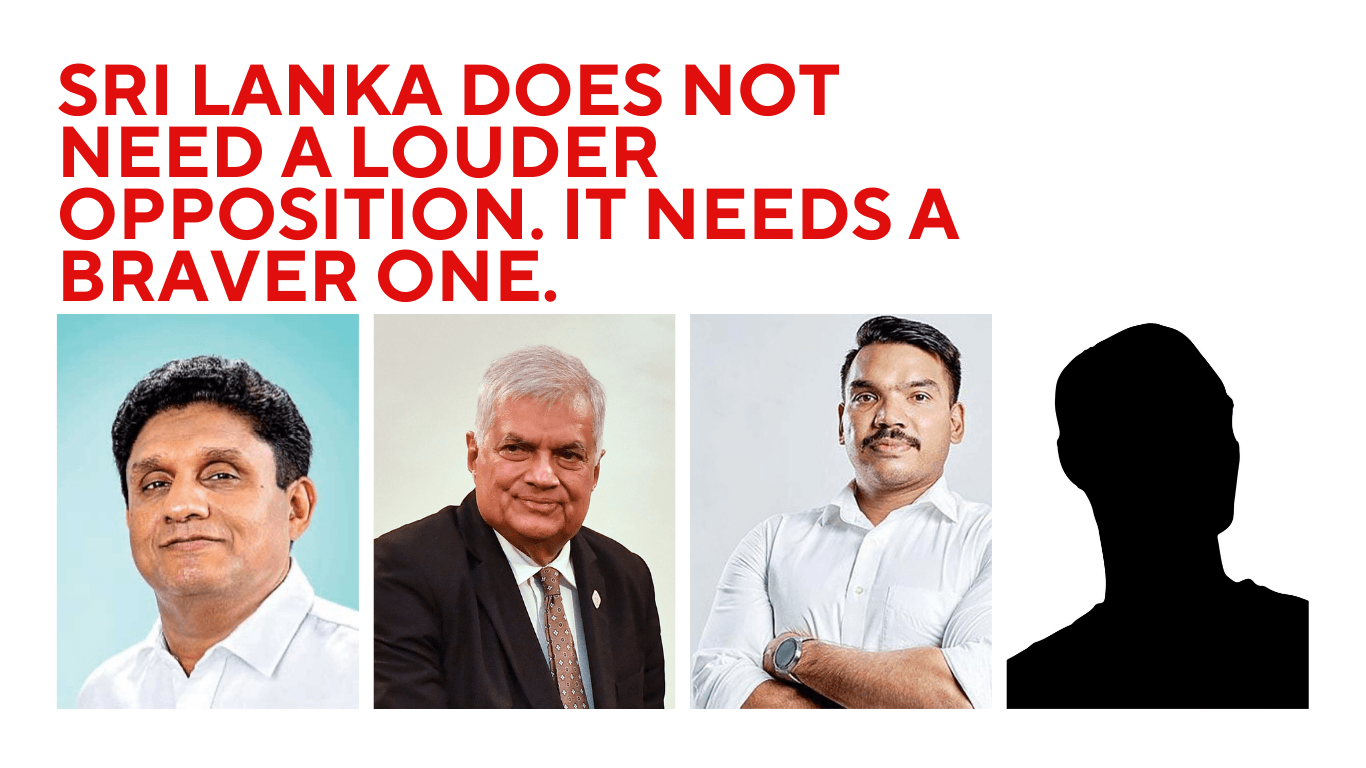
Sri Lanka does not need a louder opposition.
It does not need an angrier opposition.
It does not even need a smarter opposition.
It needs a braver opposition.
Brave enough to face its own failures.
Brave enough to reject easy populism.
Brave enough to speak brutal truths.
Brave enough to rebuild trust slowly and honestly.
Until such an opposition emerges, Sri Lanka will continue to move between failed rulers and weak alternatives. The nation has already paid a too-high price for this cycle.