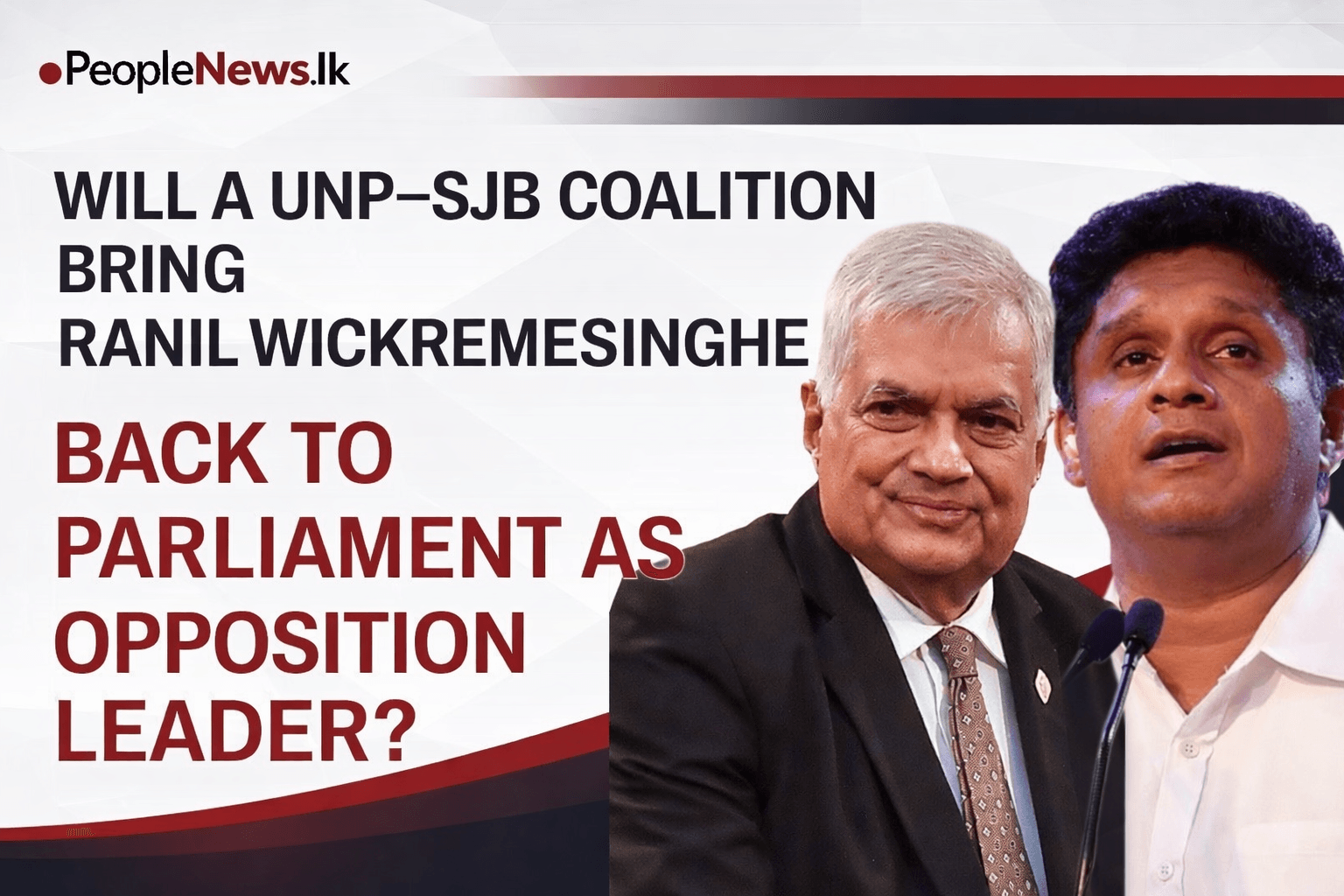
Sri Lanka’s political landscape is undergoing a subtle yet significant transformation. While public discourse remains focused on governance reforms and economic recovery, quiet strategic recalibrations are taking place within the opposition. One question increasingly circulating in political circles is whether a future understanding between the United National Party (UNP) and the Samagi Jana Balawegaya (SJB) could eventually pave the way for former President Ranil Wickremesinghe to return to Parliament as Opposition Leader.
At present, the SJB, led by Sajith Premadasa, is the officially recognised main opposition party, holding the most significant number of opposition seats in Parliament. Premadasa’s position as Opposition Leader is therefore institutionally secure. However, Sri Lanka’s political history demonstrates that parliamentary roles are rarely permanent and can shift due to alliances, legal developments, or strategic realignments.
Ranil Wickremesinghe’s Initial Political Calculation
Following the presidential transition, there was widespread speculation that the new administration led by Anura Kumara Dissanayake (AKD) would face difficulties on the international stage. Many believed that maintaining confidence among global stakeholders, including the International Monetary Fund, the United States, India, and other development partners, would be challenging.
Within this context, political observers interpreted Wickremesinghe’s initial posture as a deliberate wait-and-watch strategy. The assumption was that any instability in international relations or economic negotiations could weaken the new government, potentially creating space for his return through a positive invitation from the AKD administration as a stabilising figure with established international credibility.
However, this scenario did not materialise. The government managed to continue the IMF programme and maintain working relationships with key international partners. Consequently, the anticipated external pressure did not emerge in a decisive or destabilising manner.
In parallel, Sri Lanka’s state revenue showed unexpected improvement. Income tax collections rose sharply, driven in part by public fear of the JVP-led administration and a renewed sense of enforcement. Sections of the Sinhala community, including many who had previously neglected tax obligations for decades, began paying taxes voluntarily and without delay.
Additionally, the lifting of the vehicle import ban after two years generated substantial customs revenue. Tourism also rebounded strongly, with approximately 2.3 million arrivals recorded, despite an increase in violent shooting incidents across the country.
A key factor behind this resilience was the growing international acceptance of the “AKD brand”, which projected hope for improved governance and institutional discipline. This reinforced the government’s credibility among international stakeholders and helped sustain economic momentum.
The Breakdown of Ranil’s Expectations
Ranil Wickremesinghe also appeared to believe that the AKD leadership would show him a degree of political gratitude. His decision to contest the presidential election independently had fragmented the opposition vote, effectively preventing Sajith Premadasa from securing the presidency and indirectly enabling AKD to win. This outcome also allowed the NPP/JVP to form a government for the first time in Sri Lanka’s history.
Contrary to Ranil’s expectations, no such goodwill emerged. Instead, the new administration pursued legal action against him, reportedly driven by unresolved grievances linked to the JVP’s losses during the 1987–1990 period. He was arrested on allegations of misuse of government funds during a UK visit in the final year of his presidency.
Although he later secured bail, it became evident that the legal climate was no longer favourable. At this point, Ranil appears to have concluded that “Option A”, returning to power through collaboration with the AKD government, was no longer viable.
He also anticipated that the “Dithwa storm” and associated losses might place renewed pressure on the government and force a strategic rethink. Yet even this did not unfold as expected, as international stakeholders stepped in with continued support. Once again, the AKD government remained on a relatively stable and positive trajectory.
These developments forced Ranil Wickremesinghe into a strategic reassessment.
The Shift Towards a Party Strategy: Plan B
With the prospect of becoming Prime Minister under the AKD government increasingly remote, Ranil Wickremesinghe appears to have activated Plan B: returning to Parliament as Opposition Leader.
However, this raises a fundamental question. Sajith Premadasa currently commands the support of around 40 MPs from the SJB and its allied groups. How, then, could Ranil realistically assume the Opposition Leader’s role?
The answer lies in a quietly floated verbal proposal by Ranil and his inner circle. Notably, this proposal has not been presented in writing, despite requests from the SJB leadership. Under this proposal, Sajith Premadasa would become the leader of the UNP, while Ranil would retain only a ceremonial or honorary position within the party. In effect, the SJB would dissolve back into the UNP, restoring a unified party structure.
On the surface, this appears attractive to both UNP and SJB voters, who have long been frustrated by division within the opposition. However, Ranil Wickremesinghe is not known for easily relinquishing party leadership. Over the past two decades, he has resisted multiple internal pressures to step down. If he is now willing to do so, it suggests a deeper strategic objective.
That objective, many believe, is to reclaim the Opposition Leader position by the second half of 2026.
The Hidden Mechanics of Plan B
Even if Sajith becomes UNP leader, he would still retain his parliamentary majority and remain Opposition Leader. With the SJB MPs and additional UNP MPs combined, there would be no procedural requirement to hand over the role to Ranil.
This is where Ranil’s long-term political strategy becomes evident.
Once Sajith accepts UNP leadership, internal and external narratives questioning his effectiveness as Opposition Leader are likely to intensify. Voices within the party and allied circles would begin to argue that Ranil’s international experience and diplomatic stature are essential to mount a credible opposition capable of engaging global actors.
Former SJB MPs who return to the UNP under this arrangement would likely spearhead this campaign. Over time, Sajith could find himself increasingly isolated and politically cornered.
At that stage, Ranil could return with another carefully worded verbal proposal: Sajith would be endorsed as the UNP’s presidential candidate at the next presidential election, while Ranil temporarily resumes party leadership and assumes the Opposition Leader position in Parliament until then.
On the surface, this would appear to be a fair compromise. In reality, it would place Sajith in a problematic position, once again forced to decide under intense internal and public pressure. By then, party members and external commentators would frame acceptance as the only “reasonable” path forward.
If events unfold according to this design, Ranil Wickremesinghe’s Plan B would succeed. From his perspective, it is both more reliable and more achievable than Plan A. Crucially, regaining the Opposition Leader position would provide him with political leverage and institutional protection at a time when legal and political pressures remain acute.
Sajith Premadasa’s Dilemma and Remaining Options
Such a scenario would place Sajith Premadasa in an increasingly vulnerable position. However, he is not without options. One alternative would be to reject absorption into the UNP and instead propose a formal alliance between the SJB and UNP, with both parties retaining their separate identities. Under this arrangement, Sajith could lead the coalition rather than the UNP itself, while Ranil remains UNP leader.
This would allow Sajith to preserve the SJB as an independent political force and protect his parliamentary authority. Nevertheless, risks would remain. Once the two parties operate closely under an alliance framework, internal loyalties may gradually shift. Decisions that Sajith can command today with party backing may not receive the same support in the future.
At this critical juncture, the political test lies with Sajith Premadasa. How he responds to Ranil Wickremesinghe’s overtures will shape not only his own political future but also the structure of Sri Lanka’s opposition.
As the country continues its fragile recovery, these behind-the-scenes political calculations may soon move from speculation into tangible reality.