A Reckoning Begins
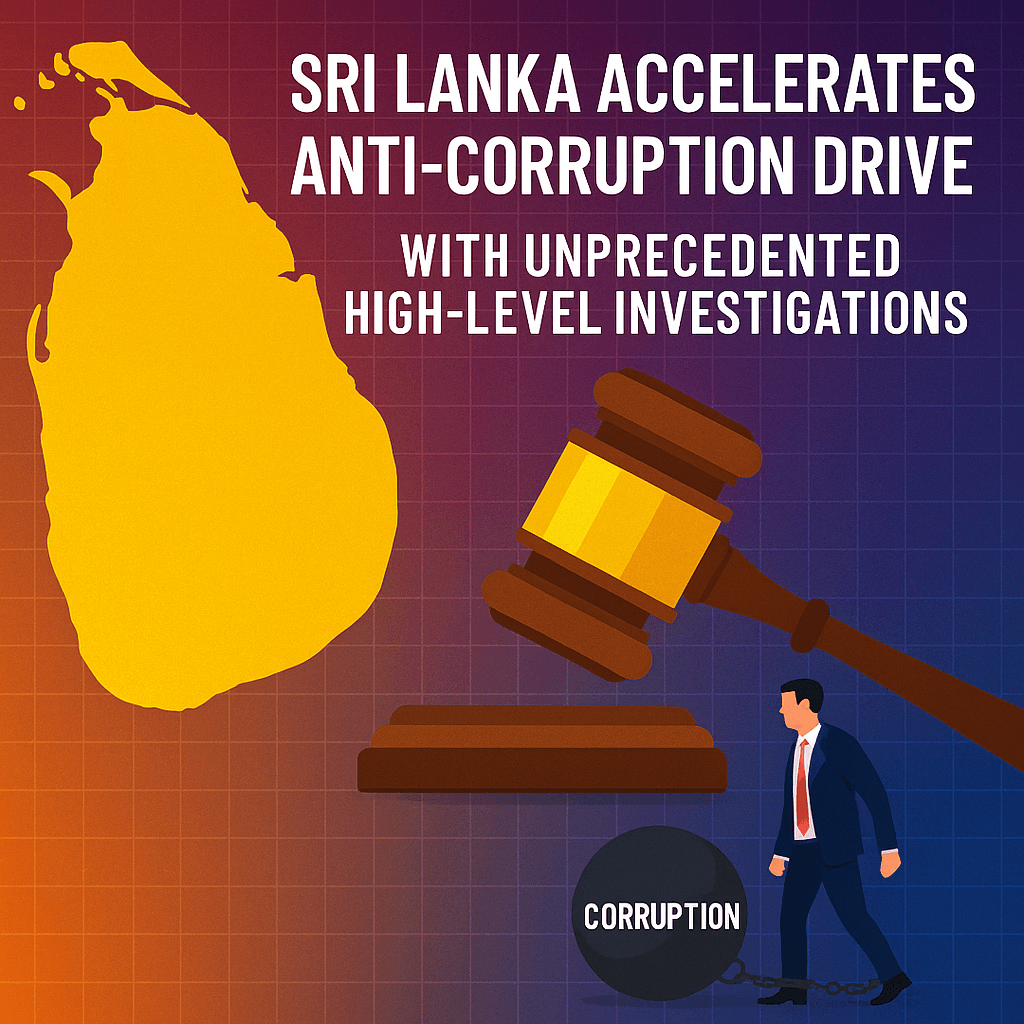
In mid-2025, Sri Lanka’s political landscape is undergoing a significant transformation. Under the leadership of President Anura Kumara Dissanayake, a renewed focus on anti-corruption has taken centre stage. The administration’s early months have seen the reactivation of long-stalled investigations and strengthening the Commission to Investigate Allegations of Bribery or Corruption (CIABOC). These developments have generated both cautious optimism and intense scrutiny across the political spectrum.
While proponents see the action as correct in reviving public confidence and affirming institutional credibility, opponents are flagging possible overreach and politicisation. For the government, it is being taken through legal means, guided by facts and backed by a new legal framework. International observers, including the UN and EU, noted the initiative and advocated for openness and compliance with the rule of law. This unfolding chapter could remodel Sri Lanka’s course of action for accountability, if supported with equality and consistency.
Unveiling the Rot
Several reopened cases have revealed the extent of past financial irregularities, particularly those linked to large infrastructure projects and offshore transactions. Investigations have focused on allegations of inflated contract values, conflict of interest, and misuse of state assets. In one case, authorities are reviewing documentation related to urban redevelopment projects where discrepancies amounting to billions of rupees have been reported.
CIABOC even worked with international agencies to track financial flows and asset allocations, probing earlier foreign exchange transactions and potential money laundering. However, legal observers say a serious inquiry and due process are necessary for credibility. As more facts come to light, public interest shifts from broad outrage to specific cases, some of which involve notable former officials.
The startling revelations also trigger critical public conversations about long-term reforms, governance accountability, and the need for systemic checks beyond political cycles.
Legal Pushback & Political Fallout
Familiar legal and political responses predictably follow high-profile inquiries. Some suspects under inquiry have taken to the courts to object to their rights and challenge the inquiry procedure. Some lawyers have cited concerns regarding the speed of investigation, thus underscoring the need to safeguard the rule of procedure.
Parliamentary oppositions have demanded monitoring mechanisms to sustain the integrity of current investigations. In the legal institutions, there are demands for maintaining public confidence alongside preserving judicial neutrality. The Department of the Attorney General has promised that all matters will be carried out based on the rule of law and customary practices of the courts.
This stage of the anticorruption campaign is testing Sri Lanka’s institutional sophistication. How the legal institutions respond, without political direction, will indicate whether the campaign reinforces or disturbs the country’s democratic balance.
Voices of the People
There is widespread public optimism, but of a guarded variety, given a history of dashed hopes. Successive administrations for many Sri Lankans have promised to clean up corruption, but little has provided lasting reform. Civil society keeps a watchful eye, urging disclosure, frequent reporting, and public availability of case data. Recent polls reflect growing confidence in free-standing watchdog institutions, but there are caveats about selective prosecution or politicisation. Student organisations and community forums have emerged prominently in the debate, pressing for corruption education and citizen engagement.
Everyone agrees that accountability is needed, from city professionals to villagers, but so too is a thorough, nonpolitical system for carrying it out. The public is clamouring for not punishment but a form of government that avoids the recurrence of corruption.
The President’s Stand
President Dissanayake has continually framed the campaign against corruption as an aspect of governance, not a political expedient. In recent speeches, he emphasised institution-building that goes beyond personal leadership. Policy initiatives include legal reforms, declarations of assets, and enhanced protection for whistleblowers.
The President is also under pressure from his governing alliance, with some political forces advocating for restraint rather than investigations of former associates. However, the government promised support for legal reform and assured that neither a current nor a former official would be exempted if corruption is substantiated.
While politically contentious, this approach received reserved approval from international organisations and transparency watchdogs. Ultimately, long-term success will reflect consistent application of the principle in practice.
The Final Pulse!!!
Sri Lanka’s anti-corruption efforts are now at a critical juncture. Observers believe the following steps, mainly how the justice system handles cases, will determine the campaign’s legitimacy. Legal scholars have recommended the creation of a fast-track judicial mechanism to handle high-stakes financial crimes with speed and fairness.
Global stakeholders, such as the IMF and World Bank, have shown interest in Sri Lanka’s institutional reforms, correlating transparency progress with overall economic assistance. Meanwhile, citizens are awaiting systemic movements behind national headlines. In a country with a long history of political cycles and unfinished reforms, sustained, rule-based enforcement could set a precedent for future governments. Whether this moment becomes a genuine turning point or another missed opportunity remains to be seen, but the public is paying close attention.