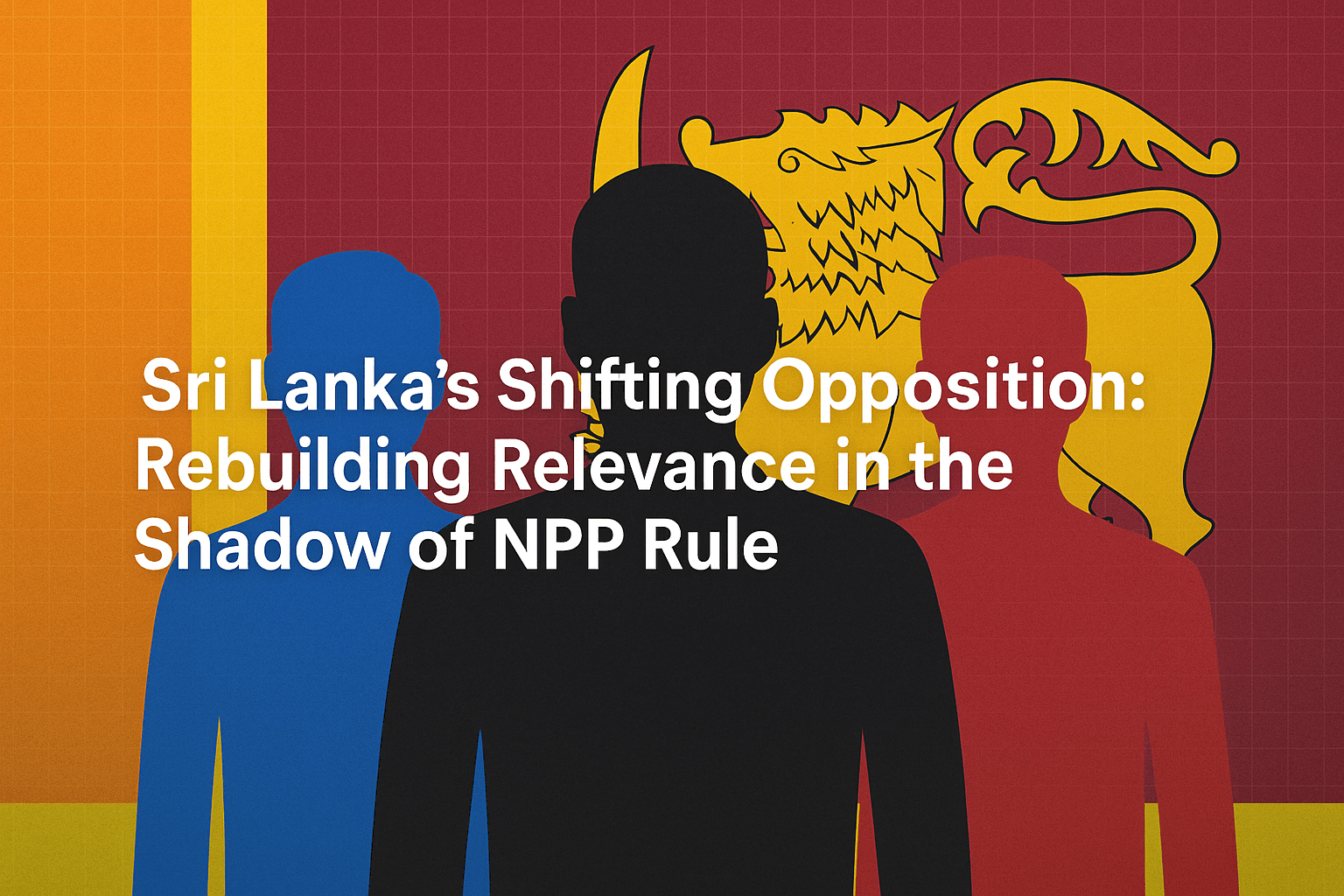
One year after the National People’s Power (NPP) came to office with a dominant parliamentary majority, the political opposition of Sri Lanka struggles in a landscape fundamentally transformed. formerly mighty parties now must operate in a landscape of reduced clout, popular distrust, and organisational disintegration. The 2024 general election did not simply bring a new government to office, it redefined political leadership expectations among the population.
In the midst of an economy recovering under the leadership of President Anura Kumara Dissanayake, the opposition parties are in a phase of reorientation. Established forces of opposition, erstwhile dominant, are redefining the role of the forces of opposition in a political system that has unmistakably moved away from political elitism. The newer, minor parties are perceiving avenues in the widening political space. In this environment, the struggle for survival as relevant as the struggle for authority.
Samagi Jana Balawegaya (SJB): The Main Opposition Force
Samagi Jana Balawegaya (SJB) of Sajith Premadasa continues to be the largest opposition bloc in Parliament. Though it has a lower seat number nowadays, holding around 40 MPs, it continues to be active in criticizing policy, especially concerning issues of price control to curb inflation, education policy, andprovincial balance. The party continues to be active in debates in the media as well as the House, trying to position itself as the centrist option between the NPP’s wave of reforms and the SLPP’s tradition-based politics.
Intra-party unity, however, continues to be a problem. The SJB has lost significant defectors in Parliament and the local councils. Kolonnawa, Beruwala, and some urban councillors have defected to the ruling NPP or aspired to be independent. These defections have precipitated party leadership discipline, but they have also underscored the SJB’s weakness at the base as well as ideological ambiguity. The survival of the SJB in the future lies in the ability of the party to evoke a new vision, one grounded in citizen-oriented governance and explicit, concrete policies as compared to reactive oratory.
Sri Lanka Podujana Peramuna (SLPP): How the Powerhouse Became the Peripheral
Just a few years ago, the SLPP commanded a supermajority and the executive presidency. Today, it finds itself reduced to a marginal presence in Parliament, with fewer than five active MPs and a fractured support base. The backlash from the 2022 economic crisis, combined with allegations of mismanagement and corruption during the Rajapaksa era, has nearly erased the SLPP’s once-iron grip on Sri Lankan politics.
Leadership of the SLPP is now diffused. The lack of a clear successor and the backtracking of major figures such as Basil and Gotabaya Rajapaksa from frontline leadership have created a leadership void. Grassroot loyalists remain, especially in Uva and South provinces, yet the party lacks traction. Its rebranding efforts are in motion, as it advocates for generational leadership and policy reinvention, yet these efforts must climb a steep hill. Without a strong new vision and more extensive coalition-building, the SLPP can potentially remain a sideline player in national life for some time to come.
Rise of Third Forces: FPC and Sarvajana Balaya
As traditional opposition parties struggle, smaller and emerging groups are beginning to reshape the political narrative. Among them, the Freedom People’s Congress (FPC), founded by breakaway SLPP MPs including Dullas Alahapperuma, is advocating a values-based, citizen-first approach. While still a minority voice, the FPC has earned respect for its parliamentary discipline and constructive criticisms. It appeals to voters disillusioned with both past excesses and current centralisation.
Sarvajana Balaya, a broad alliance of civil society groups, former bureaucrats, and minor parties, has also begun positioning itself as a moral opposition bloc. Though lacking in electoral muscle, it has found strength in public forums, policy discourse, and social media engagement. These alternative voices, while fragmented, signal a growing demand among citizens for non-traditional, principle-based politics. The road to parliamentary influence is long, but they represent a shift in public consciousness that could reshape alliances in future elections.
Local Government: Ground Zero for Political Manoeuvring
In the absence of another national election in the immediate future, local government has become the focal point of political activity. Municipal councils, urban development authorities, and provincial structures are witnessing heightened competitio, not just between ruling party and opposition, but among opposition forces themselves. The NPP’s continued expansion at the grassroots has triggered reactionary efforts by the SJB and smaller parties to retain relevance.
Some of these councils of the opposition have experienced internal divisions, as members have defected or constituted independent groups. Meanwhile, local governance failure and citizen-led agitation have given voice to civic concerns. For the opposition parties, local governance provides the opportunity to show administrative acumen and credentials of public service. These councils can be springboards of national resurgence, whoever uses them as such. They are battlegrounds of attrition and opportunity, for the time being.
Looking Ahead: Challenges and Opportunities for the Opposition.
Opposition’s biggest challenge of 2025 is not numerical, but of a philosophical kind. The voters want clarity, consistency, and bravery. No more satisfied with political recycling, the people seek clean alternatives, doable policies, and a national vision of unification. Parties that do not yield to the shift will be put in the sidelines, regardless of history credentials. But even in the bleakness of this hour, there lies great potential. If the forces of opposition, old and new, can come together behind transparency, equity, and governance, they can slowly restore public trust. The next several years will be defining ones. Constitutional reforms, economic shifts, and global pressures will challenge the political stamina of the nation. If the opposition is to be of real use in the process, it must move from critic to contributor, providing more than resistance, but rather, renewal.
The Final Pulse!!!
As Sri Lanka’s political tide continues to shift, the opposition stands at a quiet but crucial crossroads. No longer buffered by nostalgia or party legacy, survival now depends on substance. The slogans of yesterday have faded, what remains is a test of authenticity, adaptability, and action.
In the shadow of an assertive NPP-led government, the opposition’s role is no longer just resistance; it must become relevance. Whether through bold reform or humble rebuilding, the path ahead demands not just louder voices, but wiser ones. The next chapter of Sri Lankan democracy won’t be written by power alone, but by those willing to listen, evolve, and lead with purpose.